



A12
Hippocampus-kortikale Interaktionen, die schemabedingte Systeme der Gedächtniskonsolidierung unterstützen
Das Erlernen regelbasierter Navigationsaufgaben hängt von koordinierter Aktivität zwischen dem Hippocampus und Kortex während des Verhaltens ab und wird durch Schlaf nach dem Lernen unterstützt. Abstrakte Repräsentationen der Aufgabenstruktur, sogenannte Schemata, können die Integration neuer Gedächtnisinhalte unterstützen. Um die Schema-gestützte Gedächtnisintegration zu untersuchen, verwenden wir eine neue sensorische Navigationsaufgabe in Kombination mit chronischen Neuropixels-Messungen im Hippocampus–Retrosplenial–Frontalkortex-Netzwerk. Wir adressieren zwei zentrale Fragen: (1) Wie werden neue sensorisch-räumliche Assoziationen in bestehende Schemata integriert – abhängig davon, ob sie mit vorhandenen Schemata kongruent sind oder nicht; Und (2) wie unterstützen hippocampo-kortikale Interaktionen – insbesondere SWR-assoziierte Reaktivierungen während des Verhaltens und währends des Schlafs – diesen Prozess? Darüber hinaus beleuchten wir die Rolle des Hippocampus durch den Einsatz von Modellen mit transienten und chronischen Hippocampusbeeinträchtigungen, um dessen Einfluss auf Schemarepräsentationen und Gedächtnisintegration zu untersuchen. Unser Projekt soll aufdecken, wie durch das Zusammenführen von bestehenden und neuen Erinnerungen robuste und flexible Wissensstrukturen aufgebaut werden.
Bild: Torben Ott und Claudia Böhm
Graphical Abstract
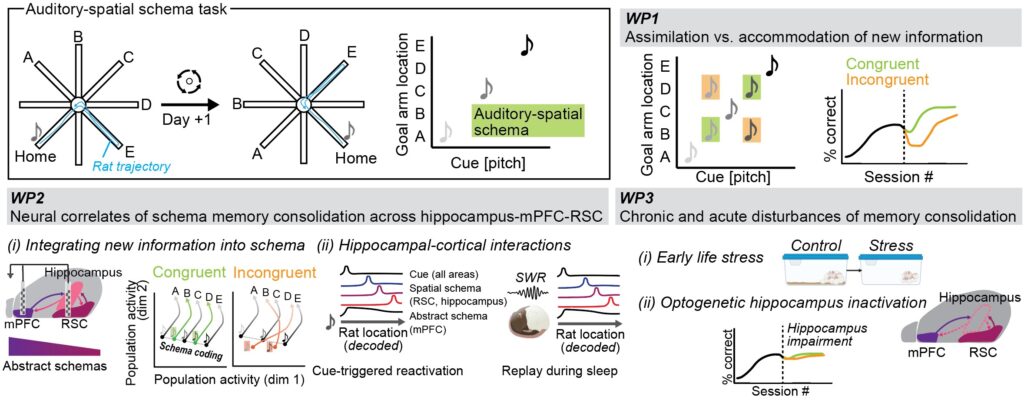
Graphical abstract: Integration of new memories into existing schemas across the hippocampal-retrosplenial-frontal cortex network in rats. In a novel auditory-spatial schema task, rats learn a mapping between the pitch of an auditory cue (playback in home arm) with the location of a goal arm (A–E). Home and goal arm locations are rotated daily with respect to distal cues. For successful navigation, rats must thus learn an abstract auditory-spatial schema. WP1: We will test how new memories are integrated into existing schemas during memory consolidation, with new congruent or incongruent information expected to show fast or slow integration, respectively. WP2: Using chronic multi-probe Neuropixels recordings in rat hippocampus, medial prefrontal cortex (mPFC), and retrosplenial cortex (RSC), we plan to identify the evolution of neural schema correlates during assimilation and accommodation of new information (i). We hypothesize that neural schema representations rapidly integrate congruent new information and require expansion for schema-incongruent information. We will assess the role of hippocampal-cortical interactions in memory integration during wakefulness and sleep, in particular sharp wave ripples (SWR)-related replay (ii). WP3: We test chronic (early life stress) and acute (optogenetics) hippocampal dependent memory consolidation impairments.