



A12
Hippocampal–cortical interactions supporting schema-dependent systems memory consolidation
The acquisition of rule-based spatial navigation tasks depends on coordinated hippocampal–cortical interactions during behavior and post-learning sleep. Abstract representations of task structure, or schemas, are thought to support the integration of new memories. To investigate schema-fascilitated memory integration we employ a novel sensory–spatial navigation task combined with chronic Neuropixels recordings in the hippocampal–retrosplenial–frontal cortex network in rats. We address two key questions: (1) how new sensory–spatial associations are integrated into existing schema representations, depending on their congruence with prior schemas; and (2) how hippocampal–cortical interactions – particularly SWR – associated reactivations during wakefulness and sleep—support this process. We will further illuminate the role of the hippocampus by using models of transient and chronic hippocampal impairments to examine the impact on schema representations and memory integration. Together our project will uncover how new and existing memories are combined to build robust yet flexible knowledge structures.
Image: Torben Ott and Claudia Böhm
Graphical Abstract
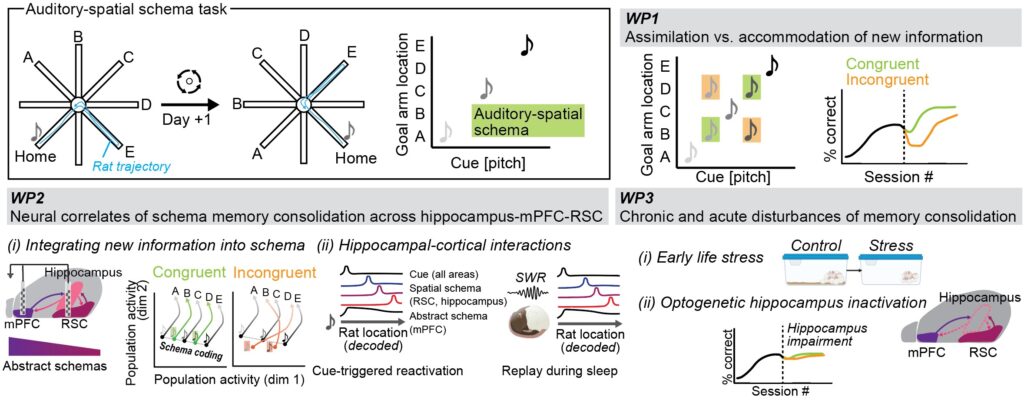
Graphical abstract: Integration of new memories into existing schemas across the hippocampal-retrosplenial-frontal cortex network in rats. In a novel auditory-spatial schema task, rats learn a mapping between the pitch of an auditory cue (playback in home arm) with the location of a goal arm (A–E). Home and goal arm locations are rotated daily with respect to distal cues. For successful navigation, rats must thus learn an abstract auditory-spatial schema. WP1: We will test how new memories are integrated into existing schemas during memory consolidation, with new congruent or incongruent information expected to show fast or slow integration, respectively. WP2: Using chronic multi-probe Neuropixels recordings in rat hippocampus, medial prefrontal cortex (mPFC), and retrosplenial cortex (RSC), we plan to identify the evolution of neural schema correlates during assimilation and accommodation of new information (i). We hypothesize that neural schema representations rapidly integrate congruent new information and require expansion for schema-incongruent information. We will assess the role of hippocampal-cortical interactions in memory integration during wakefulness and sleep, in particular sharp wave ripples (SWR)-related replay (ii). WP3: We test chronic (early life stress) and acute (optogenetics) hippocampal dependent memory consolidation impairments.