


B01
Das Schicksal von Erinnerungsspuren im Laufe der Zeit: Veränderungen der Repräsentation von Erinnerungen in Netzwerken – ein neuer theoretischer Rahmen für die systemische Gedächtniskonsolidierung
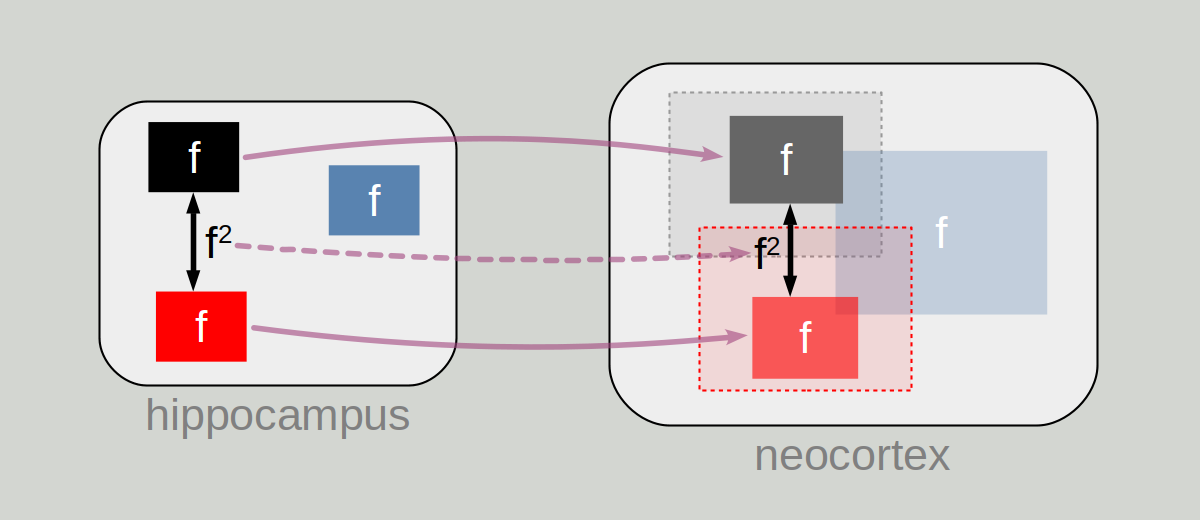
Wir schlagen einen mechanistischen Rahmen für systemische Gedächtniskonsolidierung deklarativer Erinnerungen vor, der erklärt, warum und wie sich Gedächtnissysteme reorganisieren, der motiviert, auf welche Weise sich Erinnerungen verändern, und der nahelegt, wo Erinnerungen zu welchem Zeitpunkt nach ihrem Erwerb repräsentiert sind. Wir propagieren daher eine neue Theorie, die sich nicht auf die bisher in traditionellen Modellen weit verbreitete Annahme stützt, dass deklarative Erinnerungen zunächst nur im Hippocampus gespeichert und dann in neokortikale Netzwerke übertragen werden. Ein Schlüsselelement unserer neuen Theorie ist ein Mechanismus, der die Interaktion von Gedächtnisnetzwerken erklärt und der zur Veränderung der Repräsentationen von Gedächtnisinhalten führt, was dem Ziel dient, die Lebensdauer von Gedächtnisinhalten zu verlängern und neues Lernen zu erleichtern.
Graphical Abstract
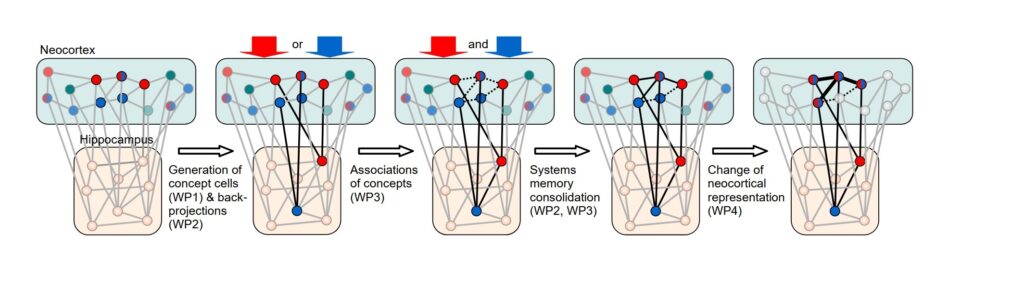
Graphical abstract: Schematic of transformations of memory representations (from left to right). The neocortex (first panel, top) has developed over years representations of concepts (selectivity of neurons color coded) of the sensory world; neurons may also exhibit mixed selectivity (e.g. half red/half blue disc); hippocampal neurons (bottom) are not selective at this early developmental stage. Important/salient concepts presented separately (second panel, colored arrows at top separated by “or”) evoke activity in concept cells in the hippocampus (bottom) via strengthened connections (black lines) (WP1). Formation of symmetric backprojections (second panel, same black lines; WP2) is required for consolidation. One-shot encoding of an association between two simultaneously presented concepts (third panel, colored arrows at top connected by “and”) strengthens connections predominantly in the hippocampus (third panel, solid lines) but also in the neocortex (dotted lines) (WP3). The association encoded in the hippocampus is transferred to the neocortex (fourth panel, solid black lines) as a result of systems memory consolidation (WP2, WP3). Repeated consolidation of associations and control of mean neocortical activity/connectivity (fifth panel, thicker black lines and changed colors of neurons) transforms the neocortical representations (WP4).
Team
-

Prof Dr Benjamin Lindner
Humboldt-Universität zu Berlin & BCCN
Head of the group Theory of Complex Systems and Neurophysics
-
Prof Dr Richard Kempter
Humboldt-Universität zu Berlin
Deputy Spokesperson, Head Theoretical Neuroscience Lab
-

Prof Dr Henning Sprekeler
Technische Universität Berlin
Head Sprekeler Lab - B01 Alumnus PI
-
Jakob Stubenrauch
Humboldt-Universität zu Berlin & BCCN
B01 PhD (AG Lindner)
-

Naomi Auer
Humboldt-Universität zu Berlin
B01 PhD
-
Ikhwan Khalid
Humboldt-Universität zu Berlin
B01 PhD (AG Kempter)
-
Lars Chen
Humboldt-Universität zu Berlin
B01 Student helper
-

Denis Alevi
Technische Universität Berlin
B01 Associate PhD
-

Dr Tiziano D’Albis
Humboldt-Universität zu Berlin
B01 Alumnus
-
Dr Eric Reifenstein
Humboldt-Universität zu Berlin
B01 Alumnus
Publications
Population sparseness determines strength of Hebbian plasticity for maximal memory lifetime in associative networks
Naomi Auer, Lars Chen, Jakob Stubenrauch, Benjamin Lindner, Richard Kempter
PLoS Comp Biol 22(7): e1013235 (2026)
Furutsu-Novikov–like cross-correlation–response relations for systems driven by shot noise
Jakob Stubenrauch and Benjamin Lindner
Phys. Rev. X 14, 041047 (2024)
Quantitative modeling of the emergence of macroscopic grid-like representations
Ikhwan Bin Khalid, Eric T. Reifenstein, Naomi Auer, Lukas Kunz, Richard Kempter
eLife (2024)
Intra-ripple frequency accommodation in an inhibitory network model for hippocampal ripple oscillations
Natalie Schieferstein , Tilo Schwalger, Benjamin Lindner, Richard Kempter
PLoS Comput Biol. 20(2): e1011886 (2024)
Hebbian plasticity in parallel synaptic pathways: A circuit mechanism for systems memory consolidation
Michiel Remme, Urs Bergmann, Denis Alevi, Susanne Schreiber, Henning Sprekeler, Richard Kempter
PLOS Comput Biol 17(12):e1009681 (2021)
A neural code for egocentric spatial maps in the human medial temporal lobe
Lukas Kunz, Armin Brandt, Peter C. Reinacher, Bernhard P. Staresina, Eric T. Reifenstein, Christoph T. Weidemann, Nora A. Herweg, Ansh Patel, Melina Tsitsiklis, Richard Kempter, Michael J. Kahana, Andreas Schulze-Bonhage, Joshua Jacobs
Neuron. 109(17) 2781-2796.e10 (2021)
Microcircuits for spatial coding in the medial entorhinal cortex
John J Tukker, Prateep Beed, Michael Brecht, Richard Kempter, Edvard I Moser, and Dietmar Schmitz
Physiol Rev. 102:653–688 (2022)
Synaptic learning rules for sequence learning
Eric T. Reifenstein, Ikhwan Bin Khalid, Richard Kempter
eLife. 10:e67171 (2021)
Learning accurate path integration in a ring attractor model of the head direction system
Pantelis Vafidis, David Owald, Tiziano D'Albis, Richard Kempter
eLife 11:e69841 (2022)
Propofol modulates early memory consolidation in humans
Daa Un Moon, Nazli Esfahani-Bayerl, Carsten Finke, Daniel J Salchow, Mario Menk, Simon Bayerl, Richard Kempter and Christoph J Ploner
eNeuro. 7(3):ENEURO.0537-19.202
Recurrent amplification of grid-cell activity
Tiziano D'Albis and Richard Kempter
Hippocampus. 30(12):1268-1297 (2020)