Interactions between long- and short-term synaptic plasticity transform temporal neural representations into spatial
Nov 11, 2026 3:30 pm CET | Charité CrossOver Virchowweg 6, 10117 Berlin | ZOOM ID: 7754910236Information processing in the brain relies on the transmission of spikes through chemical synapses whose efficacies often depend on their recent firing history. While effects of such short-term plasticity on neural information processing have long been studied, it is unclear how interactions between short-term and long-term plasticity affect the learning abilities of neural networks. Here, we show that long-term changes to the short-term plasticity of individual synaptic connections enable neurons to learn to process temporal sequences of spikes as if they were spatial patterns. This mechanism allows neural circuits to flexibly increase their capacity and robustness at the expense of elevated spiking activity. We further show that neurons with plastic short-term plasticity can learn to discriminate between inputs on the basis of multineuronal spike correlations that extend over space and time. Our model fits recent electrophysiological measurements of short term plasticity in the mouse and human neocortex and is consistent with the distributions of short term plasticity induction and recovery.
Our theory predicts that the learning rule observed at a given synaptic connection depends on the degree and type of short-term plasticity which is induced by the induction protocol for long-term plasticity.
About the Speaker
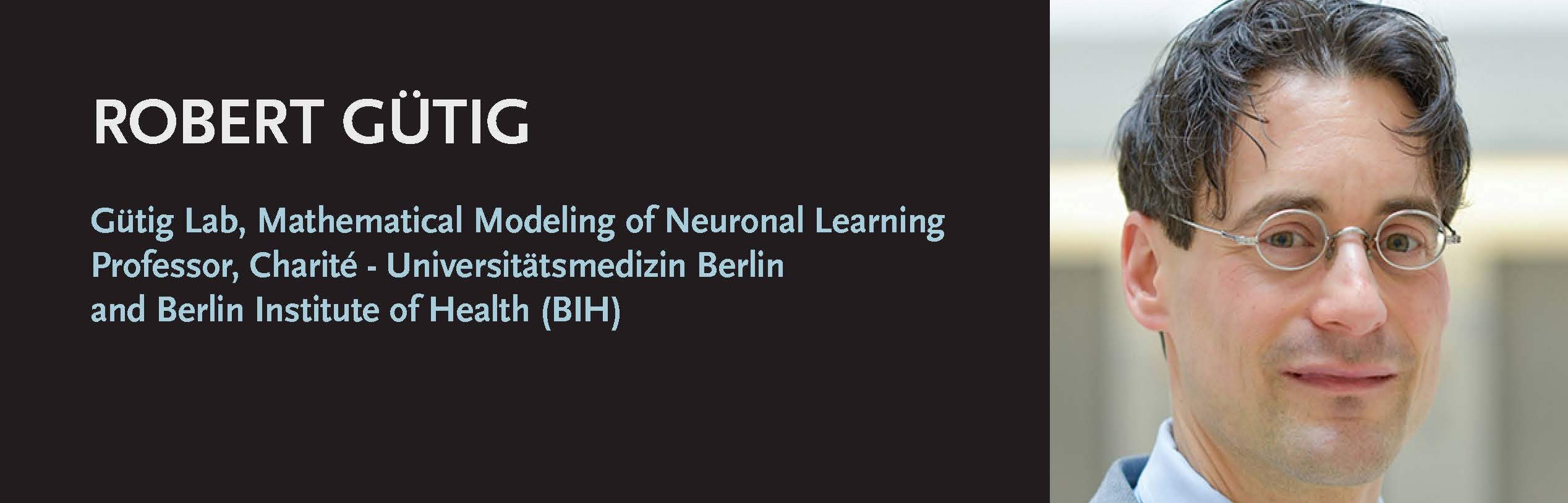
Robert Gütig is Professor of Mathematical Modeling of Neural Learning at the Berlin Institute of Health at Charité – Universitätsmedizin Berlin. He studied physics at the Free University of Berlin and earned a Master of Philosophy in theoretical physics from the University of Cambridge, followed by studies in psychology at the University of Heidelberg. He received his doctorate in computational neuroscience from the University of Freiburg. After postdoctoral work with Haim Sompolinsky at the Hebrew University of Jerusalem, he led an independent Max Planck Research Group at the Max Planck Institute of Experimental Medicine in Göttingen before joining the Berlin Institute of Health at Charité in 2018. Robert has worked abroad during extended research visits, including at RIKEN (Tokyo), Harvard University (Boston), and the KITP (Santa Barbara). His work is supported by an ERC Advanced Synergy Grant (BrainPlay), and in 2017 he received the AAAS Newcomb leveland Prize, awarded for the most outstanding paper published in Science the preceding year.
Photo courtesy of Robert Gütig.
This talk is a keynote at CRC 1315/3 9th Annual Retreat.
Certificate of attendance: Please contact team assistant Laura.Starck@hu-berlin.de