


A02
Die Rolle der Plastizität an den Ausgangssynapsen des Hippocampus für das Gedächtnis
Das Subiculum ist der Ausgangsbereich des multisynaptischen Hippocampus-Kreislaufs und spielt eine wichtige Rolle beim Gedächtnis. Pyramidenzellen im Subiculum sind funktionell heterogen und aktiv während hochfrequenter „scharfer Wellenrippeln“, die vom Subiculum über den retrosplenialen Kortex zur Konsolidierung des Langzeitgedächtnisses weitergeleitet werden. Innerhalb des Hippocampus-Kreislaufs zeigen zwei synaptische Verbindungen – Dentatgyrus (DG) zu CA3 und CA1-Subiculum – eine Form der Langzeitplastizität, die cAMP-abhängig ist und präsynaptisch induziert und exprimiert wird. Wir haben festgestellt, dass an den DG-CA3-Synapsen ein Anstieg von cAMP eine Reorganisation der synaptischen Vesikel auslöst, was zu einer Zunahme der Anzahl der angedockten Vesikel führt, die zum Pool der leicht freisetzbaren Vesikel (RRP) gehören. Die Zunahme der Vesikelverfügbarkeit könnte ein Mechanismus für die synaptische Langzeitpotenzierung sein und könnte auch für die Steuerung des Informationstransfers aus dem Hippocampus an den CA1-Subiculum-Verbindungen wichtig sein. Wir wollen untersuchen, ob die strukturelle präsynaptische Plastizität an den Synapsen zwischen CA1 und dem distalen Subiculum für die Stabilisierung des Gedächtnisses notwendig ist.
Bildnachweis: Rost9 – Magnific.com
Graphical Abstract
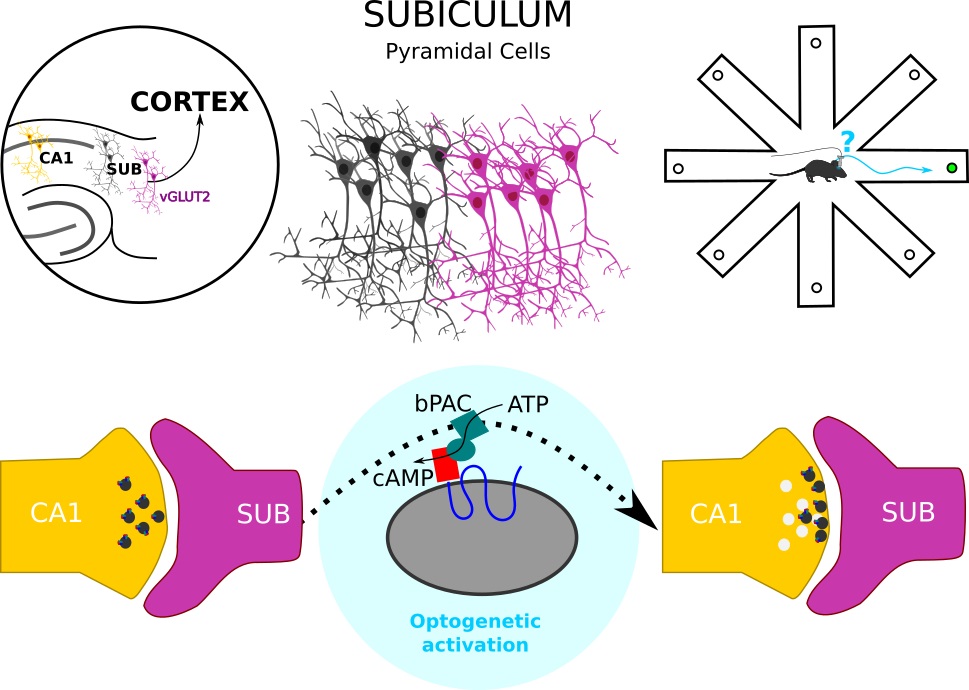
Graphical Abstract Top left: output hippocampal circuit from CA1 (yellow) to proximal subiculum (grey) and distal subiculum (purple), and from there to the cortex. Top middle: zoom in into the subiculum (SUB) with proximal pyramidal cells (grey) and vGLUT2-positive distal pyramidal cells (purple). Top right: radial arm maze behavioral paradigm with tracked trajectories to goal arm (correct trajectory in blue, goal arm in green). Bottom left: synaptic connection between CA1 and distal SUB neurons. Bottom middle: optogenetic strategy with a fusion protein of vesicular protein synaptophysin (blue line, vesicle in grey) and bPAC (photoactivated adenylyl cyclase). Bottom right – optogenetically potentiated synapse from CA1 to SUB
Team
-
Prof Dr Dietmar Schmitz
Charité-Universitätsmedizin Berlin
Head Schmitz Lab
-

Dr Marta Orlando
Charité-Universitätsmedizin Berlin
Co-Project Leader
-
Prof Dr Marta Rosário
Charité – Universitätsmedizin Berlin
Head Developmental Neurobiology, Assoc PI
-
Prof Dr med Seija Lehnardt
Charité – Universitätsmedizin Berlin
A01 A02 Associate PI
-
Dr rer nat Arend Vogt
Charité – Universitätsmedizin Berlin
A02 Postdoc
-

Dr Anton Dvorzhak
Charité-Universitätsmedizin Berlin
A02 Associate Postdoc
-

Anne Voigt
Charité-Universitätsmedizin Berlin
A02 PhD
-
Dr Noam Nitzan
Buzsaki Lab
A02 Alumnus
Publications
The flexible synapse – How mossy fiber architecture adapts to changing needs
Felicitas Bruentgens, Dietmar Schmitz, Marta Orlando
Prog Neurobiol. 258:102882 (2026)
Hippocampal commissural circuitry shows asymmetric cAMP-dependent1 synaptic plasticity
Lukas Faiss, Aikaterini Salivara, Silvia Oldani, Jörg Breustedt, Dietmar Schmitz, Benjamin R Rost
ACS Chem Neurosci. 16(21):4236−4245 (2025)
Feeding-induced olfactory cortex suppression reduces satiation
Hung Lo, Malinda L.S. Tantirigama, Anke Schoenherr, Laura Moreno-Velasquez, Lukas Faiss, Amit Kumar, Aileen Hakus, Benjamin R. Rost, Matthew E. Larkum, Benjamin Judkewitz, Katharina Stumpenhorst, Marion Rivalan, York Winter, Eleonora Russo, Wolfgang Kelsch, Dietmar Schmitz, Friedrich W. Johenning
Neuron 113: 2856-2871 (2025)
Distinct roles of cortical layer 5 subtypes in associative learning
Sara Moberg, Michele Garibbo, Camille Mazo, Ariel Gilad, Dietmar Schmitz, Rui Ponte Costa, Matthew E. Larkum, Naoya Takahashi
bioRxiv (2025)
The Lack of Synapsin Alters Presynaptic Plasticity at Hippocampal Mossy Fibers in Male Mice
Felicitas Bruentgens, Laura Moreno Velasquez, Alexander Stumpf, Daniel Parthier, Jörg Breustedt, Fabio Benfenati, Dragomir Milovanovic, Dietmar Schmitz and Marta Orlando
eNeuro. 11(7):ENEURO.0330-23.2024 (2024)
Social play behavior is driven by glycine-dependent mechanisms
Anton Dvorzhak, Michael Brecht, Dietmar Schmitz
Curr Biol. 34(16):3654-3664.e6 (2024)
Efficient generation of a self-organizing neuromuscular junction model from human pluripotent stem cells
Alessia Urzi, Ines Lahmann, Lan Vi N. Nguyen, Benjamin R. Rost, Angélica García-Pérez, Noemie Lelievre, Megan E. Merritt-Garza, Han C. Phan, Gary J. Bassell, Wilfried Rossoll, Sebastian Diecke, Severine Kunz, Dietmar Schmitz & Mina Gouti
Nat Commun. 14(1):8043 (2023)
Synthetic surprise as the foundation of the psychedelic experience
Roberto De Filippo, Dietmar Schmitz
Neurosci Biobehav Rev. 157:105538 (2024)
Play and tickling responses map to the lateral columns of the rat periaqueductal gray
Natalie Gloveli, Jean Simonnet, Wei Tang, Miguel Concha-Miranda, Eduard Maier, Anton Dvorzhak, Dietmar Schmitz and Michael Brecht
Neuron. 111, 1–12 (2023)
A bistable inhibitory OptoGPCR for multiplexed optogenetic control of neural circuits
Jonas Wietek, Adrianna Nozownik, Mauro Pulin, Inbar Saraf-Sinik, Noa Matosevich, Daniela Malan, Bobbie J. Brown, Julien Dine, Rivka Levy, Anna Litvin, Noa Regev, Suraj Subramaniam, Eyal Bitton, Asaf Benjamin, Bryan A. Copits, Philipp Sasse, Benjamin R. Rost, Dietmar Schmitz, Peter Soba, Yuval Nir, J. Simon Wiegert and Ofer Yizhar
Nat Methods (2024)
Automated Detection and Localization of Synaptic Vesicles in Electron Microscopy Images
Barbara Imbrosci, Dietmar Schmitz and Marta Orlando
eNeuro. 9(1):ENEURO.0400-20.2021 (2022)
Brain-wide interactions during hippocampal sharp wave ripples
Noam Nitzan, Rachel Swanson, Dietmar Schmitz and György Buzsáki
Proc. Natl. Acad. Sci. U.S.A. 119 (20) e2200931119 (2022)
Differential ripple propagation along the hippocampal longitudinal axis
Roberto De Filippo, Dietmar Schmitz
eLife. 12:e85488 (2023)
Calcium-permeable channelrhodopsins for the photocontrol of calcium signalling
Rodrigo G. Fernandez Lahore, Niccolò P. Pampaloni, Enrico Peter, M.-Marcel Heim, Linda Tillert, Johannes Vierock, Johannes Oppermann, Jakob Walther, Dietmar Schmitz, David Owald, Andrew J. R. Plested, Benjamin R. Rost, Peter Hegemann
Nat Commun. 13:7844 (2022)
Microcircuits for spatial coding in the medial entorhinal cortex
John J Tukker, Prateep Beed, Michael Brecht, Richard Kempter, Edvard I Moser, and Dietmar Schmitz
Physiol Rev. 102:653–688 (2022)
Recruitment of release sites underlies chemical presynaptic potentiation at hippocampal mossy fiber boutons
Marta Orlando, Anton Dvorzhak, Felicitas Bruentgens, Marta Maglione, Benjamin R. Rost, Stephan J. Sigrist, Jörg Breustedt, Dietmar Schmitz
PLoS Biol. 19(6):e3001149 (2021)
Liste aller Publikationen 2022/2-2026 (alphabetisch)
List View
A CRISPR-Cas9–engineered mouse model for GPI-anchor deficiency mirrors human phenotypes and exhibits hippocampal synaptic dysfunctions
Miguel Rodríguez de los Santos, Marion Rivalan, Friederike S. David, Alexander Stumpf, Julika Pitsch, Despina Tsortouktzidis, Laura Moreno Velasquez, Anne Voigt, Karl Schilling, Daniele Mattei, Melissa Long, Guido Vogt, Alexej Knaus, Björn Fischer-Zirnsak, Lars Wittler, Bernd Timmermann, Peter N. Robinson, Denise Horn, Stefan Mundlos, Uwe Kornak, Albert J. Becker, Dietmar Schmitz, York Winter and Peter M. Krawitz
Proc Natl Acad Sci USA. 118(2):e2014481118 (2021)
Layer 3 pyramidal cells in the medial entorhinal cortex orchestrate up-down states and entrain the deep layers differentially
Prateep Beed, Roberto de Filippo, Constance Holman, Friedrich W. Johenning, Christian Leibold, Antonio Caputi, Hannah Monyer, Dietmar Schmitz
Cell Reports. 33(10):108470 (2020)
Movement disorders after hypoxic brain injury following cardiac arrest in adults
F. Scheibe, W. J. Neumann, C. Lange, M. Scheel, C. Furth, M. Köhnlein, P. Mergenthaler, J. Schultze‐Amberger, P. Triebkorn, P. Ritter, A. A. Kühn, A. Meisel
Eur J Neurol. 27(10):1937-194 (2020)
Propagation of hippocampal ripples to the neocortex by way of a subiculum-retrosplenial pathway
Noam Nitzan, Sam McKenzie, Prateep Beed, Daniel Fine English, Silvia Oldani, John J Tukker, György Buzsáki and Dietmar Schmitz
Nat Commun. 11(1):1947 (2020)