


INF
Information infrastructure and SciOps towards reproducible science
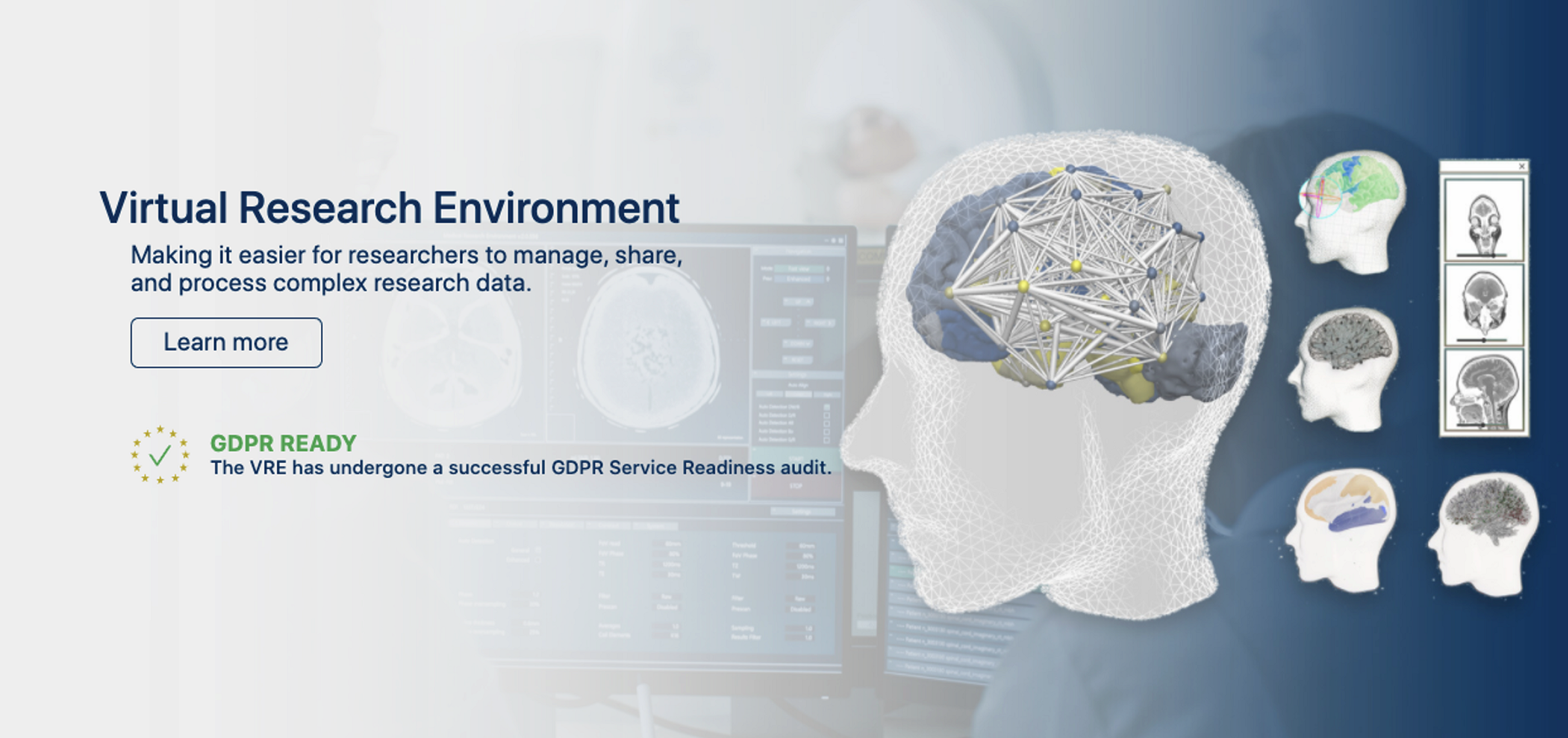
The INF project will continue to foster the collaboration between CRC1315 sub-projects and advance further the capacity of the CRC1315 consortium to integrate human, rodent and fly data, leading to the generation of neuroscientific insights and clinical applications. We will build on the infrastructure for research data management (storage, documentation, processing, sharing and publication) that has been developed and used by the consortium in period 2. We will continue providing tools and training to enable the self-consistent organization of cross-species multiscale neuroscience data and models in a common reference space. The INF sub-project is central to the CRC. It consulted with the CRC sub-projects on a regular basis in period two and will continue this frequent exchange in period three. In period two our focus was twofold. First, it was directed to our internal data management capacities, i.e. we implemented tools for data management for heterogeneous datasets within the consortium, providing training and support to maintain an up-to-date data management plan (DMP), and educate about the publication of research outputs other than classical journal contributions such as datasets, software, reagents and hardware. Second, we contributed in and took leadership of local, national and international data management activities, where we contributed actively towards the development of new standards and best practices for sharing research objects and for conduction reliable and reproducible research. The INF project has led to the production of FAIR data (Findable, Accessible, Interoperable, Reusable) data in our consortium. Scientific discovery through knowledge integration by formalizing knowledge as computational models that can be simulated and generate falsifiable predictions related to memory consolidation. In the third funding period– in addition to the continuation of data management infrastructure maintenance and data management proficiency training for the consortium – we plan to advance our consortium members capabilities with respect to principles of rigorous scientific operations to achieve higher levels of operational maturity which necessitates the adoption of new, technology-enabled methodologies and best practices. These involve digital research environments that seamlessly integrate computational, automation, and AI-driven efforts throughout the research cycle—from experimental design and data collection to analysis and dissemination, ultimately leading to closed-loop discovery. Thus, the INF sub-project will continue to guide the consortium towards greater efficiency and effectiveness in scientific research.
Graphical Abstract
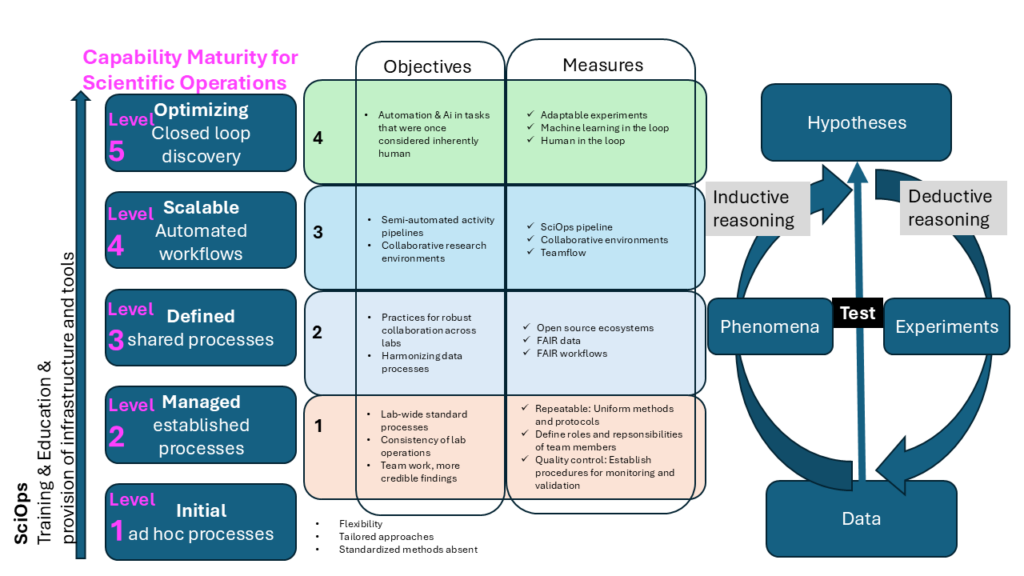
Graphic abstract: The scientific discovery loop towards an understanding of memory consolidation is supported by the INF project through fostering the proficiency for Science Operations according to the Capability Maturity Model for Science Operations ‘SciOps’ (Johnson et al. 2024).
Principal Investigators
-

Prof Dr med Petra Ritter
Charité – Universitätsmedizin Berlin
Head of the Section Brain Simulation (CCM) (Alumna PI B06)
-
Prof Matthew Larkum PhD
Humboldt-Universität zu Berlin
Spokesperson, Head Larkum Lab
-
Anna Nasr
Humboldt-Universität zu Berlin
INF PhD (A04 Associated PhD)
-

Shouvik Paul
Berlin Institute of Health at Charité (BIH)
INF Developer
-
Dr Marc Sacks
Charité – Universitätsmedizin Berlin
INF Alumnus Postdoc
-

Dr Julien Colomb
Humboldt-Universität zu Berlin
Alumnus, INF (2019-2022)
Publications
Combining cloud and Git tools in a research data management strategy for team science
Julien Colomb, Robert Mies
Bausteine FDM. 1;1-10 (2026)
Homeodynamic feedback inhibition control in whole-brain simulations
Jan Stasinski, Halgurd Taher, Jil Mona Meier, M Schirner, Dionysios Perdikis, Petra Ritter
PLoS Comput Biol 20:e1012595 (2024)
Personalized Connectome-Based Modeling in Patients with Semi-Acute Phase TBI: Relationship to Acute Neuroimaging and 6 Month Follow-Up
Tyler Good, Michael Schirner, Kelly Shen, Petra Ritter, Pratik Mukherjee, Brian Levine and Anthony Randal McIntosh
eNeuro. 9(1) (2022)
Pre- and post-surgery brain tumor multimodal magnetic resonance imaging data optimized for large scale computational modelling
Hannelore Aerts, Nigel Colenbier, Hannes Almgren, Thijs Dhollander, Javier Rasero Daparte, Kenzo Clauw, Amogh Johri, Jil Meier, Jessica Palmer, Michael Schirner, Petra Ritter & Daniele Marinazzo
Sci Data. 9, 676 (2022)
Analysis of acute COVID-19 including chronic morbidity: protocol for the deep phenotyping National Pandemic Cohort Network in Germany (NAPKON-HAP)
Fridolin Steinbeis, ....Carsten Finke, ....Petra Ritter, ... Florian Kurth & Martin Witzenrath (all authors see link)
Infection. 52, 93–104 (2024)
Virtual brain simulations reveal network-specific parameters in neurodegenerative dementias
Anita Monteverdi, Fulvia Palesi, Michael Schirner, Francesca Argentino, Mariateresa Merante, Alberto Redolfi, Francesca Conca, Laura Mazzocchi, Stefano F. Cappa, Matteo Cotta Ramusino, Alfredo Costa, Anna Pichiecchio, Lisa M. Farina, Viktor Jirsa, Petra Ritter, Claudia A.M. Gandini Wheeler-Kingshott, Egidio D’Angelo
Front Aging Neurosci. 15:1204134 (2023)
The Past, Present, and Future of the Brain Imaging Data Structure (BIDS)
Russell A. Poldrack, Christopher J. Markiewicz, Stefan Appelhoff, Yoni K. Ashar, Tibor Auer, Sylvain Baillet, Shashank Bansal, Leandro Beltrachini, Christian G. Benar, Giacomo Bertazzoli, Suyash Bhogawar, Ross W. Blair, Marta Bortoletto, Mathieu Boudreau, Teon L. Brooks, Vince D. Calhoun, Filippo Maria Castelli, Patricia Clement Alexander L. Cohen, Julien Cohen-Adad, Sasha D’Ambrosio, Gilles de Hollander, María de la Iglesia-Vayá, Alejandro de la Vega, Arnaud Delorme, Orrin Devinsky, Dejan Draschkow, Eugene Paul Duff, Elizabeth DuPre, Eric Earl, Oscar Esteban, Franklin W. Feingold, Guillaume Flandin, Anthony Galassi, Giuseppe Gallitto, Melanie Ganz, Rémi Gau, James Gholam, Satrajit S. Ghosh, Alessio Giacomel, Ashley G. Gillman, Padraig Gleeson, Alexandre Gramfort, Samuel Guay, Giacomo Guidali, Yaroslav O. Halchenko, Daniel A. Handwerker, Nell Hardcastle, Peer Herholz, Dora Hermes, Christopher J. Honey, Robert B. Innis, Horea-Ioan Ioanas, Andrew Jahn, Agah Karakuzu, David B. Keator, Gregory Kiar, Balint Kincses, Angela R. Laird, Jonathan C. Lau, Alberto Lazari, Jon Haitz Legarreta, Adam Li, Xiangrui Li, Bradley C. Love, Hanzhang Lu, Eleonora Marcantoni, Camille Maumet, Giacomo Mazzamuto, Steven L. Meisler, Mark Mikkelsen, Henk Mutsaerts, Thomas E. Nichols, Aki Nikolaidis, Gustav Nilsonne, Guiomar Niso, Martin Norgaard, Thomas W. Okell, Robert Oostenveld, Eduard Ort, Patrick J. Park, Mateusz Pawlik, Cyril R. Pernet, Franco Pestilli, Jan Petr, Christophe Phillips, Jean-Baptiste Poline, Luca Pollonini, Pradeep Reddy Raamana, Petra Ritter, Gaia Rizzo, Kay A. Robbins, Alexander P. Rockhill, Christine Rogers, Ariel Rokem, Chris Rorden, Alexandre Routier, Jose Manuel Saborit-Torres, Taylor Salo, Michael Schirner, Robert E. Smith, Tamas Spisak, Julia Sprenger, Nicole C. Swann, Martin Szinte, Sylvain Takerkart, Bertrand Thirion, Adam G. Thomas, Sajjad Torabian, Gael Varoquaux, Bradley Voytek, Julius Welzel, Martin Wilson, Tal Yarkoni, and Krzysztof J. Gorgolewski
Imaging Neurosci (Camb). 8;2:1-19 (2024)
A lesion-aware automated processing framework for clinical stroke magnetic resonance imaging
Patrik Bey, Kiret Dhinds, Amrit Kashyap, Michael Schirner, Jan Feldheim, Marlene Bönstrup, Robert Schulz, Bastian Cheng, Götz Thomalla, Christian Gerloff, Petra Ritter
Hum Brain Mapp 2024;45:e26701 (2024)
Whole-brain modeling of the differential influences of amyloid-beta and tau in Alzheimer’s disease
Gustavo Patow, Leon Stefanovski, Petra Ritter, Gustavo Deco, Xenia Kobeleva and for the
Alzheimer’s Disease Neuroimaging InitiativeAlz Res Therapy. 15, 210 (2023)
Scale-free functional brain networks exhibit increased connectivity, are more integrated and less segregated in patients with Parkinson’s disease following dopaminergic treatment
Orestis Stylianou, Zalan Kaposzta, Akos Czoch, Leon Stefanovski, Andriy Yabluchanskiy, Frigyes Samuel Racz, Petra Ritter, Andras Eke, Peter Mukli
Fractal Fract. 6(12):737 (2022)
White-matter degradation and dynamical compensation support age-related functional alterations in human brain
Spase Petkoski, Petra Ritter, Viktor K Jirsa
Cereb Cortex. 33(10):6241-6256 (2023)
A deep learning approach to estimating initial conditions of Brain Network Models in reference to measured fMRI data
Amrit Kashyap, Sergey Plis, Petra Ritter and Shella Keilholz
Front. Neurosci. 17:1159914 (2023)
Evolution and adoption of contributor role ontologies and taxonomies
Mohammad Hosseini, Julien Colomb, Alex O. Holcombe, Barbara Kern, Nicole A. Vasilevsky, Kristi L. Holmes
Learn Publ. (2022)
Dynamic primitives of brain network interaction
Michael Schirner, Xiaolu Kong, B.T. Thomas Yeo, Gustavo Deco, Petra Ritter
NeuroImage. 250:118928 (2022)
Overcoming the Reproducibility Crisis – Results of the first Community Survey of the German National Research Data Infrastructure for Neuroscience
Carsten M. Klingner, Michael Denker, Sonja Grün, Michael Hanke, Steffen Oeltze-Jafra, Frank W. Ohl, Janina Radny, Stefan Rotter, Hansjörg Scherberger, Alexandra Stein, Thomas Wachtler, Otto W. Witte, Petra Ritter
bioRxiv (2022)
Research data management in clinical neuroscience: the national research data infrastructure initiative
Carsten M. Klingner, Petra Ritter, Stefan Brodoehl, Christian Gaser, André Scherag, Daniel Güllmar, Felix Rosenow, Ulf Ziemann und Otto W. Witte
Neuroforum. 27(1):35-43 (2021)
NFDI-Neuro: Building a community for neuroscience research data management in Germany
Thomas Wachtler, Pavol Bauer, Michael Denker, Sonja Grün, Michael Hanke, Jan Klein, Steffen Oeltze-Jafra, Petra Ritter, Stefan Rotter, Hansjörg Scherberger, Alexandra Stein und Otto W. Witte
Neuroforum. 27(1):3-15 (2021)
Brain simulation as a cloud service: The Virtual Brain on EBRAINS
Michael Schirner, Lia Domide, Dionysios Perdikis, Paul Triebkorn,...., Agnes Flöel, ...Jochen Mersmann, Viktor Jirsa, Petra Ritter
NeuroImage. 251:118973 (2022)
Virtual deep brain stimulation: Multiscale co-simulation of a spiking basal ganglia model and a whole-brain mean field model with The Virtual Brain
Jil M. Meier, Dionysios Perdikis, André Blickensdörfer, Leon Stefanovski, Qin Liu, Oliver Maith, Helge Ü. Dinkelbach, Javier Baladron, Fred H. Hamker, Petra Ritter
Exp Neurol. 354:114111 (2022)
The importance of standards for sharing of computational models and data
Russell A. Poldrack, Franklin Feingold, Michael J. Frank, Padraig Gleeson, Gilles de Hollander, Quentin JM Huys, Bradley C. Love, Christopher J. Markiewicz, Rosalyn Moran, Petra Ritter, Timothy T. Rogers, Brandon M. Turner, Tal Yarkoni, Ming Zhan, Jonathan D. Cohen
Comput Brain & Behav. 2(3-4):229-232 (2019)