
The neuropixels probe: a large-scale high-density electrophysiology technology platform for recording 100000 neurons simultaneously in rodents and “big” brains
Dec 8, 2026 4:00 pm CET | BCCN Lecture Hall Philippstraße 13, 10115 | ZOOM ID: 7754910236Recent advances in integration of integrated CMOS and Mems technologyon a 200/300mm CMOS wafer plat- form, has enabled the realization of active integrated neural devices, and increased routine extracellular elec- trophysiology recording capability and capacity from dozens to thousands of neurons. Extending these integrated micro-systems, the Neuropixels
platform, will enable next generation systems to visualize 10’s to 100’s of thousand neurons. I will review our work to develop, very high channel count next generation electrophysiology probe device: “the Neuropixels 3.0 probes”, and the associated system and the prospect for another 10X increase in neural recording capacity, and address progress towards recording 100000 neurons simultaneously in mamma-lian (rodents to humans) brains. Recent progress and plans for “large scale high resolution electrophysiology in “big brains” ie primates and humans in intraoperative and semi-chronic(emu) based patients will be discussed.
In addition, I will show early results on co-integrating different modalities such as integrated optics/photonics and show results in optical tagging application and a roadmap to address different modulation options. Furthermore, I will highlight the power of the Neuropixels ecosystem which is a new way to enable collaborative science between advanced toolbuilders and scientists, with transformational impact.
About the Speaker:
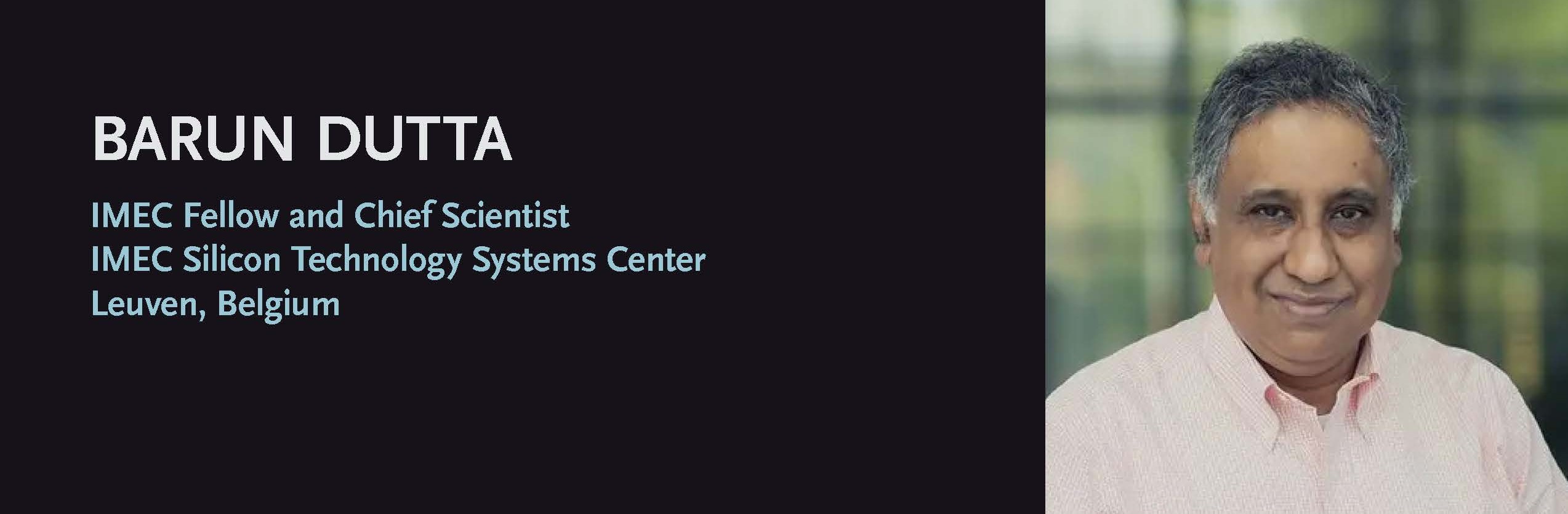
Barun Dutta has been at IMEC since 2010, where he is an IMEC Fellow and Chief Scientist of IMEC’s Silicon Technology Systems Center, leading R&D programs in semiconductor and nanotechnlogy, materials, processes and devices. From 1998-2010, he was Venture Capitalist at Alta Berkeley and Sevin Rosen Funds. He spent the first decade of his career, from 1988- 1998, as a Member of Technical Staff at Bellcore/Bell Labs, doing research in various areas semiconductor materials, process devices and circuits technology and an assignee ot IMEC. He was educated and received under-graduate and graduate degrees, from Middlebury Colege, Middlebury, VT and the Massachusetts Institute of Technology, Combridge, MA respectively.
Image courtesy of Barun Dutta
Host: This talk is hosted by Claudia Böhm (A12 subproject co-PI)
Certificate of attendance: Please contact laura.starck(at)hu-berlin.de